Our Approach
Midwest Stability Network is being developed around a single guiding principle: long-term stability is not achieved through crisis response alone, but through structure, predictability, and intentional progression over time.
Rather than reacting to emergencies, our approach is designed to prevent repeated instability by building systems that support durable outcomes for individuals and the communities they return to.
A Systems-Based Model
Many existing models prioritize immediate relief without sufficient structure for what follows. While emergency support can be necessary, it is not sufficient on its own to create lasting stability.
Midwest Stability Network is being designed as a systems-based initiative—one that emphasizes clear expectations, phased progression, and accountability at every stage. Stability is treated not as a moment, but as a process that must be built, reinforced, and maintained.
Phased Reintegration
Our conceptual framework is organized around phased reintegration. Each phase is intended to build upon the previous one, allowing individuals to progress only when stability benchmarks are met.
Rather than a single transition from instability to independence, this model recognizes that durable reintegration requires time, structure, and consistency. Progression is intentional, measured, and supported by predictable systems rather than improvised responses.
Structure and Predictability
Predictability is a core element of stability. When systems are inconsistent or unclear, instability compounds.
Midwest Stability Network’s approach emphasizes:
-
Clear expectations
-
Consistent routines
-
Defined responsibilities
-
Transparent progression criteria
By prioritizing structure, the model is designed to support better decision-making and reduce the volatility that often undermines long-term outcomes.

Accountability as Support
Accountability is not treated as punishment, but as a stabilizing force. Our approach integrates accountability as a form of support—providing clarity, boundaries, and responsibility that help individuals maintain progress over time.
This includes mutual accountability: participants commit to engagement and responsibility, while the organization commits to consistency, fairness, and transparency.
Avoiding Large-Metro System Failures
Many large metropolitan areas struggle with housing instability despite substantial funding and extensive service networks. These challenges often stem from scale-driven issues such as fragmented service delivery, crisis saturation, inconsistent enforcement of standards, and systems that prioritize volume over outcomes.
Midwest Stability Network is intentionally designed to avoid these pitfalls.
Our approach emphasizes:
-
Controlled scale, allowing systems to remain coherent and enforceable
-
Clear boundaries, preventing mission drift and indefinite dependency
-
Measured growth, rather than rapid expansion driven by demand alone
-
Outcome-focused design, instead of throughput-based metrics
By operating in a manageable environment and prioritizing system integrity over scale, Midwest Stability Network aims to build a model that reinforces stability rather than inadvertently institutionalizing instability.
Sustainability Over Scale
Midwest Stability Network is being developed with sustainability as a priority. Programs will not be launched until the necessary governance, funding, partnerships, and operational safeguards are in place.
Growth is intended to be deliberate rather than rapid. Expansion will be considered only after systems demonstrate reliability, outcomes can be measured, and long-term viability is established.
Designed Before Deployed
This initiative is currently in its foundational development phase. Our approach is being carefully designed, evaluated, and refined prior to implementation.
By investing in planning and structure upfront, Midwest Stability Network aims to avoid the risks associated with under-resourced or prematurely launched programs, ensuring that when services begin, they are capable of delivering lasting impact.
A Responsible Path Forward
Our approach reflects a commitment to doing this work responsibly—for participants, supporters, and the broader community. Stability is not improvised. It is built through discipline, patience, and systems that endure.
Midwest Stability Network exists to develop those systems.
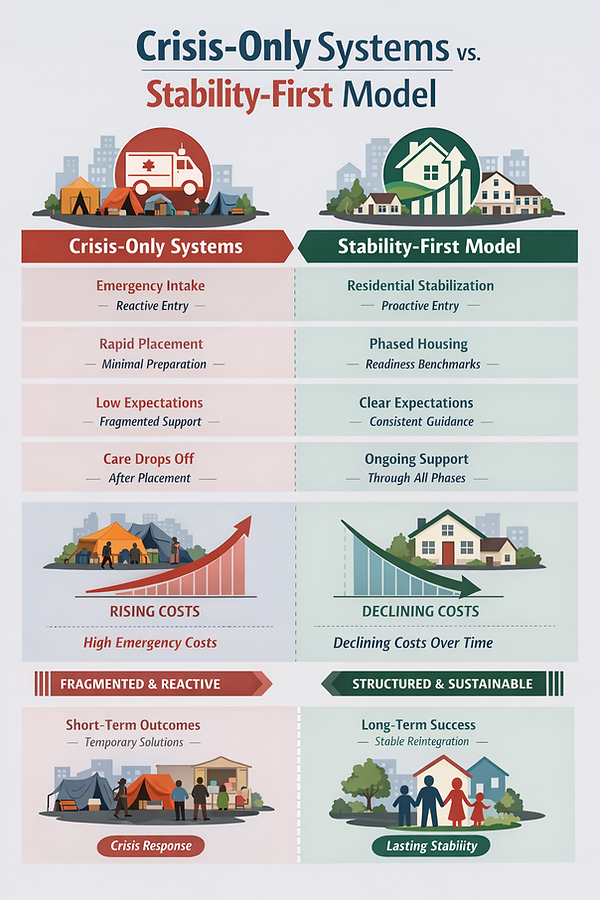
Large metros like Seattle and Los Angeles illustrate what happens when housing instability is addressed primarily through scale, speed, and crisis response, without sufficient structure or continuity. Over time, several system-level issues emerged: Crisis-Driven Design Programs prioritize emergency response and rapid placement, often without long-term stabilization plans. This creates repeated system entry when placements fail. Low-Barrier Without Structure Removing barriers without adding structure leads to environments that are difficult to maintain, both for participants and surrounding communities. Fragmented Accountability Services are distributed across multiple agencies with unclear responsibility for long-term outcomes, resulting in handoffs instead of continuity. Encampment Normalization When systems cannot maintain stability indoors, informal outdoor living becomes normalized, increasing public health, safety, and cost burdens. Escalating Public Costs Emergency services, law enforcement, healthcare, and sanitation costs rise dramatically when instability becomes chronic rather than transitional. Importantly, these outcomes were not caused by compassion, but by systems designed without durability as a primary goal.
HOW MIDWEST STABILITY NETWORK AVOIDS THESE ISSUES BY DESIGN
Midwest Stability Network was intentionally structured to address the specific failure points seen in large-scale urban responses.
1. Stability Before Autonomy
Rather than immediate placement, the program begins with structured residential stabilization, ensuring routines, expectations, and predictability are established before independence is introduced.
This reduces early placement failure.
2. Structure Paired With Support
The program avoids both extremes:
-
Not punitive or exclusionary
-
Not unstructured or permissive
Clear expectations exist at every phase, paired with consistent support and accountability.
3. Staged Reintegration, Not Sudden Placement
Participants move through defined phases, with gradual increases in responsibility. There is no “cliff” where support abruptly ends after housing placement.
4. Continuity of Responsibility
Midwest Stability Network maintains program responsibility beyond placement. The organization does not disengage once housing is achieved, which reduces repeated system entry.
5. Capacity-Conscious Growth
The program scales intentionally based on staffing, housing availability, and funding—avoiding the overextension that contributes to system breakdown in larger cities.
6. Clear Scope Boundaries
The organization does not attempt to replace:
-
Medical care
-
Mental health treatment
-
Emergency services
By staying within a defined non-clinical scope, the program avoids mission creep and regulatory overload.
7. Community Integration, Not Containment
The goal is not to manage visible homelessness, but to return individuals to stable participation in the community through housing, employment pathways, and long-term connection.